


(Note: These tutorials are meant to provide
illustrative examples of how to use the AMBER software suite to carry out
simulations that can be run on a simple workstation in a reasonable period of
time. They do not necessarily provide the optimal choice of parameters or
methods for the particular application area.)
Copyright Ross Walker 2010
Nudged Elastic Band (NEB) simulations
Formerly known as TUTORIAL A5: The Nudged Elastic Band Approach to Finding the Lowest Energy Pathway Between two States
By Christina Bergonzo, Carlos Simmerling & Ross Walker
 |
Psi |
|
Phi |
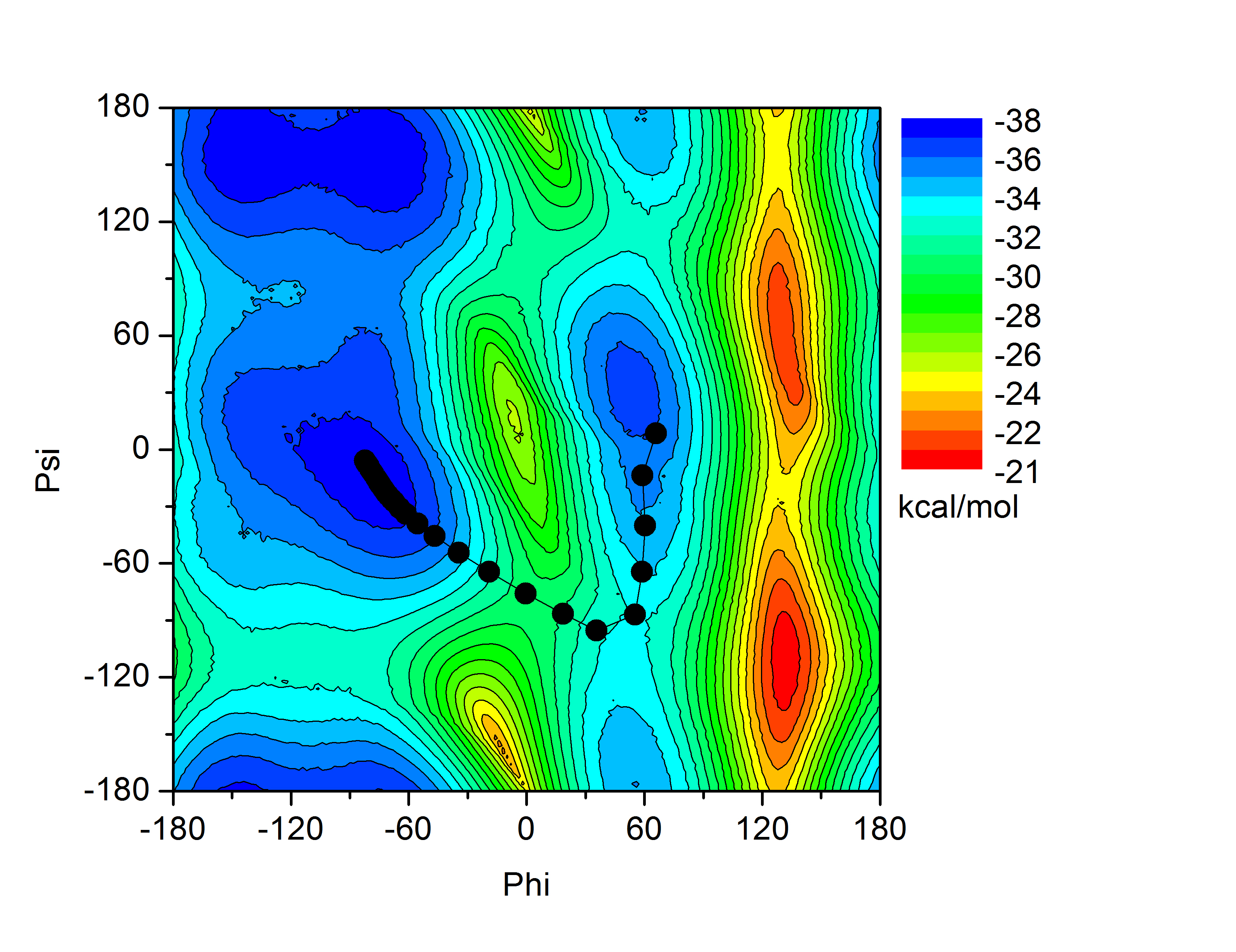
Potential Energy Scan for Phi/Psi Rotation of Alanine Dipeptide.
Dots show path found by Nudged Elastic Band (NEB) method.
The surface was calculated by scanning the two angles and extracting the energy
represented by the amber force field.
This tutorial introduces the Nudged Elastic Band method for finding low energy pathways for transitions. This feature has been significantly updated in Amber v11 and as such you will require a copy of AMBER 11 to complete this tutorial. For details on how to obtain AMBER v11.0 please see the amber website. For details of the AMBER 11 NEB installation please see:
-
Bergonzo, C., Campbell, A.J., Walker, R.C., Simmerling, C., "A Partial Nudged Elastic Band Implementation for Use with Large or Explicitly Solvated Large Systems", Int. J. Quant. Chem., 2009, 109, 15, 3781-3790
This tutorial will show you how to use a simulated annealing version of Nudged Elastic Band (NEB) to locate a low energy transition pathway for the Phi-Psi isomerization of alanine dipeptide. The use of simulated annealing means that it is not necessary to provide an initial guess at the pathway, merely the end points will do. Secondly using simulated annealing means that the algorithm will not remain trapped in the local minimum.
This tutorial consists of seven sections: